Dogs

If you submit an application to SHUG and you have an electronic or invisible fence, we're going to say no.
It's December . . . have your dogs seen the vet this year? If not, it's time to schedule an
This is John. John is an old fart. He's been an old fart for quite a while and when he turned 13
How can you help more adoptable dogs get the spays and neuters they need to join their new families? By
The Sighthound Underground can’t do what it does without foster homes. And we have some awesome foster homes – from
As most of our supporters know by now, SHUG has a flat adoption fee of $750 for imported dogs. Our
We adopted Indy (Jax Intrepid) in September 2013 after losing our previous greyhound to bone cancer. A couple of days
Some tips and tricks to keep your Golden Oldies shining into their twilight years . . . Mobility Assistance Next
I’ve often been asked why I adopt and love senior Sighthounds so much. There’s a good reason I get that

We Say No to Electronic Fences

If you submit an application to SHUG and you have an electronic or invisible fence, we're going to say no. We aren't saying you don't love your dog. We aren't saying you're a bad dog owner. We are saying NO to electronic/invisible fences.

There aren't a lot of things that make us say no here at SHUG. We like to say yes. We know Sighthound lovers often have more dogs than "normal" people. (Normal?!?! What's normal?) We understand titers, raw diets, homeopathic and alternative medicine. Our adopters live in the country and the city, in houses and condos and apartments and come from all walks of life.

But when it comes to electronic or invisible fences, we say no.

The bottom line is that electronic fences do not protect your dog from danger--other dogs and wild animals and humans with bad intentions. In the case of a Sighthound especially, the electric fence can even put them in greater danger. Because they can attain speeds of up to 45mph in just three strides, the "buzz" or "zap" of the fence won't stop them from leaving if they're chasing something. It will, however, keep them from slinking home after the chase has ended.

This weekend a horrible tragedy reminded us all again why electronic fences are such a bad idea. On Saturday evening, Michael J. McCann received a call from a friend that her dog Dimitri was missing and she was afraid he had been attacked by a coyote.

"I ran over with my infrared camera, as it was after dark. It took us over an hour, but, we found him a couple hundred yards from home. He had fought off the coyote and most likely tried to get home. The shock collar around his neck had prevented his return, so he went back into the woods to lay down to die. When we found him he was pretty torn up with a temp of 94°F. It looks like we got to him just in time.

Invisible fencing is not going to keep animals, or other threats out of your yard. If your dog runs through the barrier in pursuit of a critter, he's going to get corrected by that collar if he tries to get back. Please don't even think about installing this: especially for greyhounds."

Yesterday Dimitri succumbed to his injuries. His family is devastated. Dimitri was LOVED.

We're sharing this story to honor his memory and to hopefully educate other dog owners about the dangers of electronic or invisible fences. If you have one, get rid of it. Dig it up. Throw it away. Throw the collars away. Don't tell yourself you just won't use it. Every time it rains, you'll face temptation. THROW IT AWAY. If you don't have a physical fence, keep your dog on a leash. Please.

Check Your Chip!

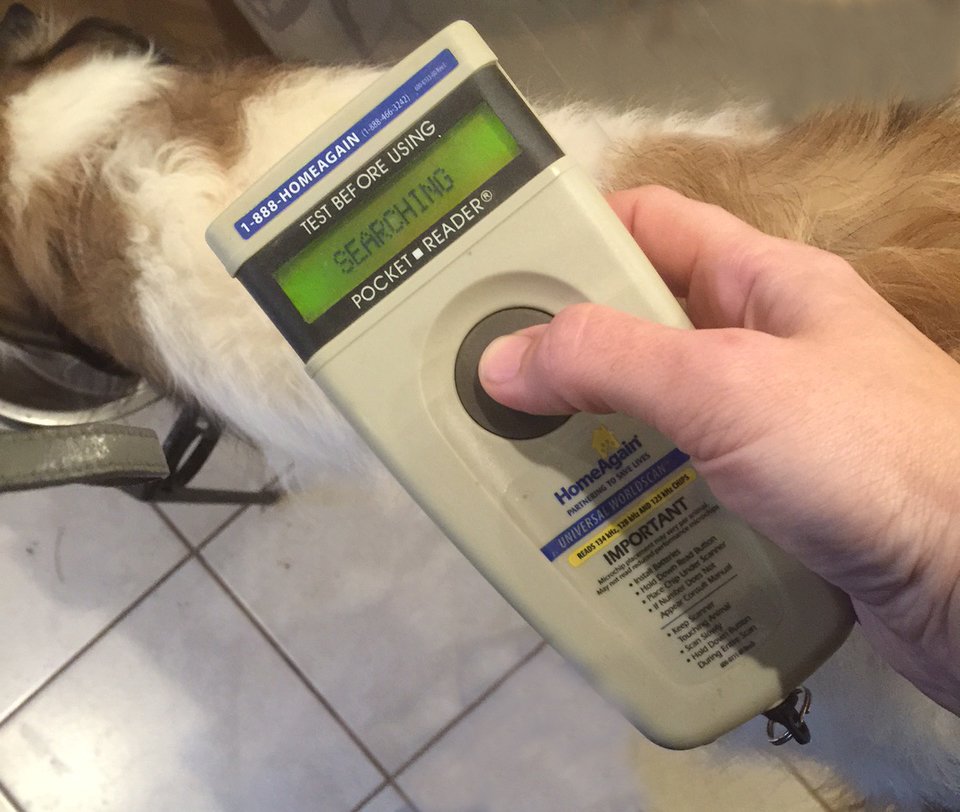
It's December . . . have your dogs seen the vet this year? If not, it's time to schedule an annual checkup. In addition to updating your dog's required vaccinations, listening to his or her heart and lungs, checking eyes, ears, and mouths, the veterinarian should also be breaking out this cool device. chip reader2

This is a chip scanner and all vet offices should have at least one on hand. When your dog is microchipped, the veterinarian who inserted the chip should have checked your dog for an existing chip before hand. Ideally your dog should only be chipped once. If you do have to "double chip" your dog for some reason, make sure that BOTH numbers are registered.

Registering your chip (or chips) is very important. When someone finds a lost dog, they often take them to the nearest veterinarian--especially if they have a dog themselves. Out comes the magic scanner! If the dog is chipped, the vet calls the number in and--if the chip is registered--the owner is contacted and there's a happy reunion that bypasses a visit to the animal shelter.

The reason the chip should be checked before it is inserted is that chips are not perfect. Sometimes they don't work because they are defective. And sometimes they fail. The chip that is supposed to reunite you and your dog if you're ever separated will only work . . . if it works.

So please, take your dog in for their annual checkup and remind your vet to CHECK THE CHIP. Your dog should never leave home without it!

From the Director: Non-Anesthesia Dentals

JohnThis is John. John is an old fart. He's been an old fart for quite a while and when he turned 13 this past August he became a really, really old fart. So . . . no more anesthesia for John. As anyone who loves Sighthounds know, you have to be cautious with anesthesia even with young, healthy dogs. For a senior, every time you put them under you're rolling the dice. I am John's mom. And I am not a gambler.

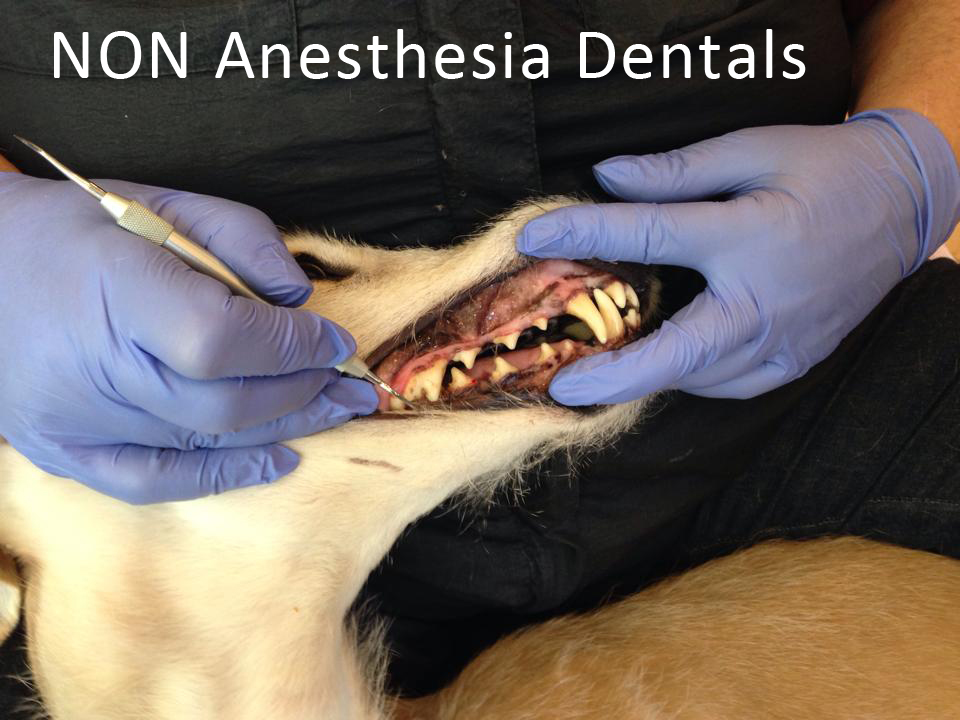
This is where non-anesthesia dentals comes in. Once or twice a year, the lovely Kathy of Houndstooth Pet Dentals flies in from California to clean John's teeth. When we started planning our Spa Day for Spay Days event, offering non-anesthesia dentals was one of our first ideas and we were thrilled that Kathy could join us. Now that the event is getting close, we're getting a lot of questions about these dentals, so here you go!

There are more and more people who offer "cleanings", so this information refers specifically to the Houndstooth services. Kathy does supra and sub-gingival scaling, ultrasonic scaling, and polishing. She doesn't just "scrape" the teeth as many owners do at home. She uses special tools to give a professional "vet office" cleaning and polishes the teeth afterward. The polishing is key because it prevents the "grooving" in the tooth surface that can encourage the regrowth of bacteria.

In addition to Kathy's training in dental hygiene, she's also a pro at handling dogs. My little guy Ozzie was one of the first of my dogs that Kathy ever worked on. He was around 12 years old and a rotten little beast. He hated strangers. He pooped on Kathy. Seriously, he pooped on her. But Kathy never lost her cool. She held him firmly, cleaned his teeth, and laughed at him when she was done and he walked away with his head in the air. I cleaned up the poop.

So if you have a rotten little dog . . . or big dog . . . or pointy dog . . . or even (gasp!) a cat . . . bring them out to our event in Frederick, MD and let them poop on Kathy while she cleans their teeth. It's fun for everyone!

Also, there will be beer.

#SpaDay4SpayDays

Sunday, September 20th

Frederick, MD

more info


#SpaDay4SpayDays in Frederick, MD

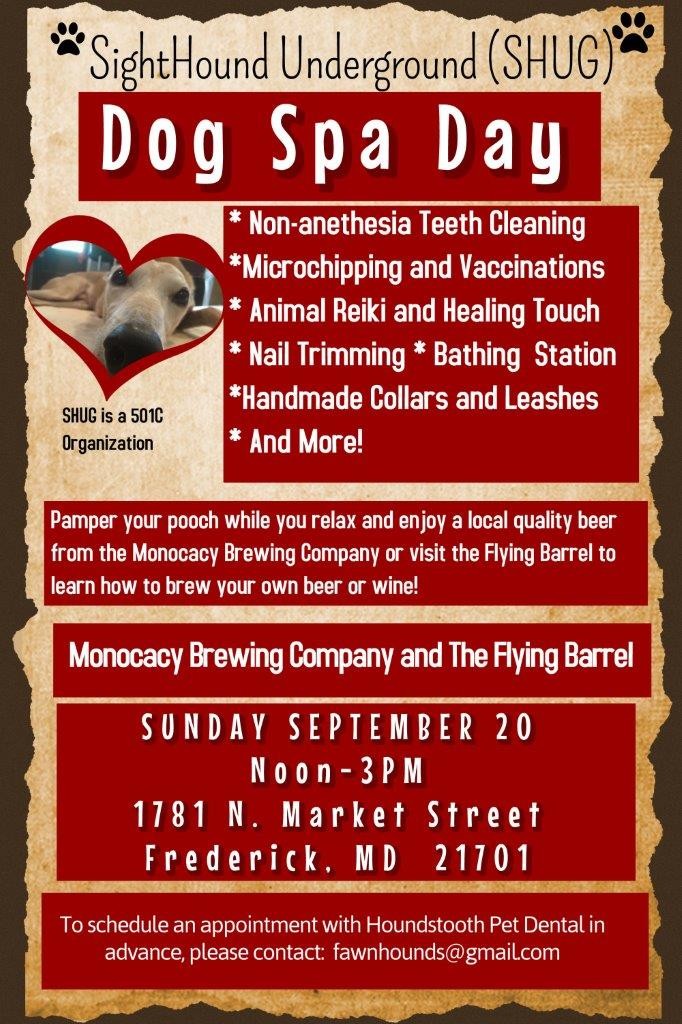
How can you help more adoptable dogs get the spays and neuters they need to join their new families? By pampering your own dog, of course! #SpaDay4SpayDays is an event in Frederick, MD on Sunday, September 20th from 11am-3pm. Bring your dog out to the Monocacy Brewing Company's Beer Garden and treat your dog to the finer things in life--and yourself to some of the finer beers, too!

Sunday, September 20th

11am - 3pm

1781 N. Market Street

Frederick, MD 21701

All of the proceeds from this event will fund spays and neuters for adoptable dogs!

To schedule an appointment for a non-anesthesia dental for your dog, please send an email to fawnhounds@gmail.com.


Why Foster? Let Us Count The Reasons . . .

The Sighthound Underground can’t do what it does without foster homes. And we have some awesome foster homes – from Washington, D.C., to Washington state and every place in between. But, like other good things – we can always use one more.

Are you interested in fostering a SHUG dog? Let’s ask our awesome fosters a simple question: Why foster?

Kristie in Maryland -- I could yammer forever. Rewards? Knowing that because of you that dog gets to know what love and family is. They don't have to face the world alone anymore. It’s about being part of someone meeting their best friend, of meeting a new part of their heart. We’ve watched Lego use his leg again. We’ve seen Zeevah feel secure and safe. We’ve watched scared nervous dogs learn they don't have to be afraid anymore. We played a part in Pilar going from the bottom of a well to a sofa. The list is endless really.

Elizabeth in Indiana -- It depends somewhat on what dog I'm fostering. With greyhounds, there are lots of firsts as the entire world is new. Watching them playing with toys, walking them in a neighborhood, etc. With Galgos . . . some have been mistreated. I remember when Bobby first arrived. I was baking and I picked up a teaspoon. He cowered as if he thought I would hit him with it. He wanted to snuggle so badly on the couch. Within a few days he was learning to play and learning I would not hurt him. I love seeing them go to their forever homes. I love getting updates on how they are doing. Facebook is great for that.

fosterbambiBonnie in Illinois -- I think it is wonderful to watch the dogs unfold and learn about a different world. It’s nice to hand-off a dog to its new owner and to hear how the foster dog is doing in its forever home. I have a well-established pack of my own and the pack always welcomes a new dog in and gives it some security while it learns more about people.

Kim in Iowa -- Sue and I love Sighthounds. We have many -- we want them all. How to accomplish this?  Why, foster, of course.  Three of our dogs are "foster failures," but in the past year, we’ve lived with six or seven additional dogs.  We’ve had an Irish wolfhound, a Greyhound, a few Galgos and an Afghan hound. Some of the dogs had some emotional issues, some had been abused or traumatized, some were just plain abandoned. They all had one thing in common: they were among the most loving, dear, sweet animals on earth.  We were able to watch how they began to love and trust. They let us into their lives, and we were privileged to have the honor. But best of all, at the end of our time together, we knew each of these dogs would finally have the home they so richly deserved.

Erica in New York -- Originally we decided to foster because our dogs were getting older and we hoped to adopt a larger Sighthound, and we wanted to see how they'd fit in our household. We foster both for a local greyhound group, GAGR, and SHUG. It's been a great experience--we've enjoyed having the fosters here as playmates for our dogs, but we're also happy to see them move on to their permanent homes. In the past 9 months, we lost both of our remaining old dogs; but we ended up adopting first a Galgo from SHUG, then a greyhound from GAGR.  And we’re continuing to foster for both groups. We were used to having four dogs anyway! By only having two of them 'forever' and the others only temporarily, we can help more dogs than if we adopted two more dogs. This way, we can allow many more dogs to stay in a safe place until they're ready to move onto their forever homes.

Tonya in Michigan -- Whenever I have a foster, someone inevitably says "well, maybe YOU will keep her." I tell them no because if I do, I can't save another life. I get to be the difference in whether a dog gets to live or die. Maybe not the dog I have directly but because I foster, and other people like me foster, there is room to take in more dogs. I get to make a difference. As for letting them go... I'm not going to lie. It's SO difficult. You can't help but fall in love with your fosters. Handing them over to their adoptive homes hurts for a little while. Then you see your foster is happy with his new family. You see the smiles on the family's face. Not only have you changed that dog's life, but you've changed that family's life as well. And you start all over again . . .

Have we convinced you to give it a try? Fill out our foster application here.

From the Director: Meet Gala!

As most of our supporters know by now, SHUG has a flat adoption fee of $750 for imported dogs. Our average cost per dog is around $850, so we subsidize our adoptions through donations and our various fundraisers. The $850 includes the dog's airfare ($200-400), their crate ($35-200), the shelter's fee to cover their vaccinations and spay/neuter and paperwork ($125-300), and transportation to the airport (up to $500).
Carlos at the airport

What we don't factor into our average dog cost or our adoption fees is the price of the human's ticket. Dogs fly from Spain as baggage and need to be attached to a human passenger. SHUG generally relies on dog friendly travelers who are flying from Spain on vacation. This keeps our cost low--but it also means there can sometimes be several dogs waiting for flights. Occasionally we will receive donated airline miles and sometimes flights are so cheap we will spring for a ticket.

And sometimes, as happened today, we'll have an adopter donate a ticket to bring over their dog. Tomorrow Carlos turns six months old--and he will celebrate that milestone in his forever home. What is even more wonderful is that because his mom donated a ticket to bring him over, another dog got to fly as well.
IMG_4134
Meet Gala!
Meet Gala. Five days ago I had never seen her. When we decided on Monday to book a flight for today, I knew we had maybe 24 hours to identify a dog to fly with him. It takes time to get a dog ready to fly and we were cutting it close. One of the first people I contacted was Diane Hughes of Ibizan Hound Rescue, the rescue that Carlos was coming from. Although IHR is a small rescue, they're volunteers go the extra mile--literally!--to get dogs into homes. Diane has sent both her husband and her brother to the U.S. with dogs and Diane's brother David, often drives our dogs to the airport in Madrid--an all day trip that starts in the early hours of the morning.
Diane sent me pictures of three dogs that she could have ready to fly in what amounted to three days. The first two were great dogs . . . but when I saw Gala, my heart pitter-pattered! Now, in the interests of full disclosure, Gala is a Galgo/Podenco cross and the love of my life, Josephina also happens to be a Galgo/Podenco cross. I also happen to be mildly obsessed with wirehaired dogs. So let's just say, I have a type. And Gala is totally my type.
So without knowing a whole lot about Gala, I jumped up and down and said yes. Dark and early Friday morning she drove to the airport with Carlos, David, and our flight volunteer Barbara Galloway of Alibar Dog Knits. Almost immediately I started hearing about how wonderful she was from everyone who came in contact with her. When the flight landed in Chicago, the accolades continued. Not only is Gala a beauty--but she's amazingly sweet and calm. And she gives kisses!!
IMG_4133
Gala is so pretty!

The plan is for Gala to hitch a ride to Wheeling, WV where SHUG volunteers will be descending for the Greyt Escape event next weekend. I can't wait to meet this sweetheart in person! After that Gala will be coming back to SHUG HQ and be fostered on the east coast. So if you're ready to adopt, check out our application online!

First Person: Indy’s Story

We adopted Indy (Jax Intrepid) in September 2013 after losing our previous greyhound to bone cancer. A couple of days prior to putting our beloved Bree down, I decided I needed something to look forward to after a month of sadness. I completed an application with our local greyhound adoption group, but they had no available dogs and they suggested I look at SHUG.

When I went to visit Indy, it was love at first sight and a week later, he came home with us.

He was a little unsure at first and had no clue how to “play,” especially with another dog. But our lab Annie was relentless. She kept dropping toys in front of him and running away. She’d wiggle and bark and run circles around him.  It took about two weeks and then they were racing around the yard together and playing “bitey face.” Having been with a previous Greyhound, Annie already knew all the tricks to keep up with a faster dog and how to play gently.

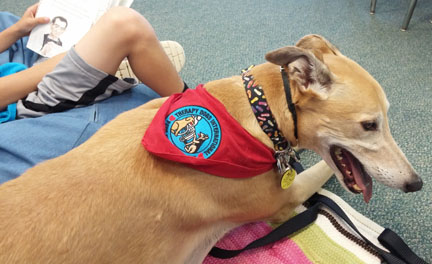
Bree had been a registered Therapy Dog volunteering as a Tail Waggin Tutor in our local elementary school. I hoped Indy could take her place. We started dog obedience in the late fall. Having trained many dogs, I have decided that although greyhounds are generally very polite and generally do fine without dog obedience, they are the hardest to actually train. We survived Level 1 (even learning how to sit), but needed a break before Level 2 to give the concepts time to sink in. We took Level 2 in the spring of 2014. Indy received his Canine Good Citizen Certification in the late spring.

indy2We took an eight-week Therapy Dog prep class to give us additional practice before taking the Therapy Dog test. Greyhounds make perfect Therapy Dogs with their relaxed and loving personalities (plus they are perfect wheelchair height), but the obedience piece of the test for them is always the hardest. The class gave us a chance to see how he did with various medical equipment (he didn’t care), funny hats and props like puppets and balloons (he didn’t care), chaotic environments (he didn’t care). I knew the hardest part of the test for Indy to pass would be NOT taking a dog cookie from someone in a walker (the new ”Leave it” test) and the two-minute down stay.  Fortunately, former racing Greyhounds are exempt from the two-minute sit stay.

All the training (plus a little luck) paid off. Indy passed his test on the first attempt. He received his Therapy Dog credentials in September 2014, one year after we adopted him. He volunteered the 2014/2015 school year, letting 3rd graders read to him every week. Everyone looked forward to Wednesday afternoons -- when Indy came to school.

In addition to Therapy Dog visits, Indy also does meet and greets for the local Greyhound rescue.

It has been a wonderful experience watching Indy learn to be part of a family. From learning to play with Annie, to understanding which cats he could nuzzle and which he couldn’t, to finally learning to snuggle with me, he becomes more a part of us every day.  He sees his Therapy Dog bag and goes nuts, running in circles and barking until you put his “uniform” on. I’m so glad we were pointed in his direction almost two years ago. I look forward to him being part of our family for many years to come.

First Person is an occasional series where we hear from SHUG adopters and supports. The author of this post is Dee Waldruff.


First Person – The Value of the Golden Oldies, Part II

Some tips and tricks to keep your Golden Oldies shining into their twilight years . . .

Mobility Assistance

Next to food and supplements (see Tuesday's post), the next biggest challenge -- and reward -- when caring for your senior pup is keeping them active and helping them get around easier.

The first thing to consider is your own environment. Gone are the days you need to “puppy proof.” Now you need to “senior proof” your home.

Rugs & Flooring: Do you have mainly all carpet or do you have a lot of slippery wood and ceramic tile floors? Rugs can be great to help your senior get around, but be sure to get rugs that have rubber backing to help them grip the floor. You can also try boots on your dog’s feet, but keep in mind that boots can also have an adverse effect and can trip the dog up if they drag their back feet on the floor. Some of the more popular and inexpensive examples include Pawz waterproof disposable dog boots, Thera-Paws, and even baby socks. A relatively new product is called Dr. Buzby’s ToeGrips, nonslip toenail grips that fit onto each nail. Keep in mind there’s a learning curve for your dog for each one of these products. Also be sure to add some extra rugs around beds that are on slick floors. If your senior falls off the bed onto the slippery floor, he may not be able to get up on his own.

Harness: A harness, such as the Ruffwear Webmaster harness, includes a handle on the top that is handy in assisting wobbly dogs. A step up from the Webmaster harness is the Help’EmUp harness, which costs about twice that of the Webmaster. It includes not one but two handles on top, one above the back and one over the hips. This harness also has various walking accessories including a shoulder strap and a strap that that allows you to hold the front and back with one handle.

Sling: A good item to help get your hound in and out of the car and around the house in case of an injury is a fleece mobility sling that can be found on Amazon, among many other online retailers.

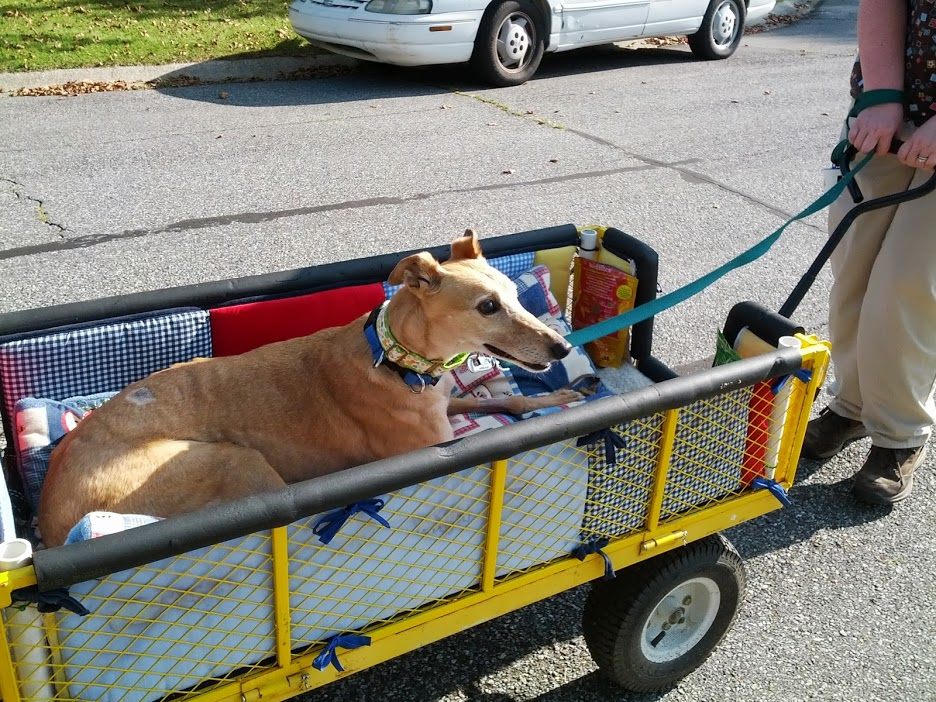
Cart: If your hound likes to get out on the town but his legs just won’t allow that, consider pulling him around in a cart. (See above!) Some nifty ideas include a child’s large wagon or garden cart, available at home improvement stores. Some more expensive alternatives made for especially dogs are available, too. There may be a learning curve for the dog, so practice around the house to get them used to it will come in handy before going out on a long excursion.

senior2Limiting Access: As your dog ages, eyesight and coordination also start to fail. You may want to consider limiting the area they have access to when you’re not home. A senior dog can easily fall down stairs or off a sofa, and you won’t know until you return home. If they insist on getting on the furniture while you’re gone, consider adding a rug underneath for them to jump down on.

Another thing to consider for a senior pup are good beds – orthopedic beds are great. The secret, though, is to be sure the bed isn’t too soft. Beds that are too soft are harder to get out of without help. Beds with bolster sides are great for seniors with mobility problems. They can use the sides to lie against and to help themselves get up.

Also, as your dog ages, he may not be able to hold himself like he once was able to. Please do not get mad if your senior wets in the house. If it starts happening regularly, have the vet make sure it’s not due to a urinary tract infection. There are also a variety of drug options – some prescription and some over-the-counter – particularly for older female dogs who leak. If you’re gone all day for work, you may want to consider either coming home at lunchtime to let your dog relieve himself or hiring a dog walker. If neither of those options are possible, consider getting large pee pads to put down in dog’s area. These can be either the disposable type or jumbo-sized mattress-type pads with rubber lining. The disposable type can be slippery if placed on a slick floor so you’ll need to take the floor you’re placing them on into consideration.

What is the bottom line when keeping your older dog comfortable, healthy, and happy? Pay attention. Consider what you can do to help them feel safe and secure. Put yourself in their paws and think about how scared you’d be if you started losing sight, hearing, and the ability to smell and taste good foods. With just a little modification to your home, your dog’s daily routine, and the addition of supplements, you can help your senior live longer and thrive.

For me, there’s no greater reward than seeing a 13-year-old pup climb stairs for the first time in many years with our help. Or better yet, see a 14-year-old enjoy her meal, even while battling her kidney disease. It’s rewarding to watch your pup thrive even in the twilight of her life.

If you’ve ever considered adopting a senior, please do so. There’s nothing better than their love, and I can assure you will be richly rewarded.

First Person is an occasional series featuring SHUG adopters and supporters. The author is Tracey McLaurin.

First Person – The Value of the Golden Oldies, Part I

I’ve often been asked why I adopt and love senior Sighthounds so much. There’s a good reason I get that question.  I do have two youngsters -- Cole, age 5 and Penny, age 4. But I have half a dozen oldies:

Sarah, age 13
Eve, age 12 (retired brood mama)
Silver, age 10 (retired stud dog)
Marina and Eris, two 10-year-old littermates
Sally, Eve’s daughter, age 9

All are Greyhounds. To round out the pack, we also have 3 senior Italian Greyhounds and a 13-year-old beagle/basset mix who thinks he’s a Sighthound.

So here’s my answer: I love seniors so much because they give me way more than I could ever give them. And they’ve taught me so much about strength, determination, and the will to live in the face of adversity.

Eve
Eve

When I adopted our first brood mama, I thought that she was a “senior” at the ripe old age of eight. (Most vets will consider a dog a senior between seven and 10.) Since then I’ve realized that Eve was really just middle-aged as far as Greyhounds go. It’s possible for our sighthounds to live much longer than we might think -- with the proper assistance from us.

The key is to be flexible, be willing to go that little extra mile and, most importantly, to be observant and know what’s normal (and not normal) for your dog. Coming up with a well-rounded plan can go a long way to help your senior stay happy, comfortable, and secure as they age.

Of course, senior pups need to have regular vet visits and you need to have a good relationship with your vet. If your senior either has an existing medical condition or is over the age of 10 or 11, I recommend twice-a-year vet visits. This will help you keep a check on their weight and also get the vet’s opinion on things like their teeth, eyes, feet, and any current lumps and bumps. Your vet will typically recommend regular blood work for seniors, sometimes called a senior panel, and you may even be offered a discount for doing blood work, urinalysis, and a fecal check all at the same time.

“Senior-hood” is also the time to start discussing necessary versus un-necessary vaccinations with your vet. As our pets become elderly, it’s often more harmful for them to have what some consider “optional” vaccinations. There’s lots of new information available weighing the risks versus the benefits. You may also want to consider taking your senior to a chiropractor or a vet who does acupuncture and/or Chinese herbs if they’re having any type of issue such as joint pain or back or hip problems.

Just as important as your relationship with the vet, senior pups have special needs related to two main areas: food and supplements, and mobility assistance.

Food and Supplements

While it’s not necessary for a senior dog to be on what’s considered a “senior” food, it is important that the food be of good quality. But it also cannot be too rich for their digestive system. Some seniors don’t handle high protein foods well, particularly if their kidneys aren’t working like they used to.

Remember that as your hounds age, their senses of smell and taste can decline, so it’s important to feed them a food that they’ll enjoy. If needed, don’t hesitate to change it up for them. A change in food may be just what they need! Dogs with kidney disease are notorious for losing their appetite so it might be a bit more challenging to tempt them to eat.  Satin balls (see below) can help. But if you’re still finding that your senior gives his food the thumbs down, talk to your vet. A prescription for an appetite stimulant such as mirtazapine might be in order.

In addition to a quality food, senior pups may need some additional nutritional and supplement help.

Oils: The addition of a good oil such as coconut, fish, olive, or flax seed is helpful, particularly for dry skin. Coconut oil can also be rubbed onto the skin and coat providing a great shine. And the additional benefit of rubbing coconut oil into their coat is that it also allows you to examine their body for any new lumps and bumps.

Ensure/Satin Balls: If your senior hound has lost some weight and needs a little boost, try giving them Ensure nutrition shakes in the original vanilla flavor. (I recommend no more than ¼ cups two or three times a day, but you need to slowly work them up to that amount and watch for diarrhea.) You can also try something called satin balls. These “meatballs” pack a powerful yummy punch, and a lot of dogs will knock you over trying to get them out of your hand! You can easily make up a large batch and freeze extras for later.

Joint Supplements: If you don’t already give your senior a joint supplement, it’s never too late to start! You’ll get many different opinions about the correct amount and which brand, but as long as you’re giving them something, that’s all that counts. You can find joint supplements in a wide variety of chewable pills and treats or even granules. At the bare minimum, a good supplement should contain glucosamine and chondroitin, which promote joint health and joint pain relief. Other additional ingredients include MSM and Vitamin C, which promotes healing and bone health, prevent urinary tract infections, and can help older dogs with hip-dysplasia symptoms. Vitamin C should be avoided, however, if your dog has a history of or increased risk for oxalate bladder stones. As concentration varies from supplement to supplement, consult bottle directions for dosing guidance.

Milk Thistle: Milk thistle helps promote detox and liver health in dogs. This is particularly useful if your dog is on an anti-inflammatory such as Rimadyl, which can be particularly hard on the liver. The dosage is 1/4 tsp milk thistle tincture per 20lbs, divided between 2 or 3 doses each day.

Curcumin: This helps promote brain and joint health and is known for its anti-cancer properties. Curcumin is a derivative of turmeric and is available in a small, concentrated, orange supplement. The dosage begins at 5mg per 20lbs daily. You can gradually increase that to 20mg per 20lbs daily.

Check back Thursday for Part II. I’ll talk mobility -- harnesses, slings, even a cool cart for getting your senior around. Oh, and yes, a bit about how to handle incontinence as well.

First Person is an occasional series featuring SHUG adopters and supporters. The author is Tracey McLaurin.